Showing posts with label seattle. Show all posts

Wednesday, August 18, 2010

Review: The Immaculate Conception of Little Dizzle

Writer/director David Russo's The Immaculate Conception of Little Dizzle continues the rapid expansion of Seattle's cinematic language we've been witnessing recently.
If the film has a traditional story, it is as follows: a young computer programmer suddenly comes down with an existential crisis, compelling him to bombastically quit his cubicle and get a job a with a corporate custodial service. One of the companies in the office building he cleans tests experimental cookies, to which he becomes addicted. Then things get weird.
The film has just enough brilliant sequences to keep us interested, including a clever riff on the "Flight of the Bumble Bee" scene from A Clockwork Orange, and yet another instance where the mere repetition of the the word fuck equals hilarity (although slicker than the opening of Four Weddings and a Funeral, it is still not as genius as this scene from an early episode of The Wire). But perhaps the most original scene is the first one: a rapid-fire journey following a message in a bottle through the waters of Puget Sound to a pebble beach in Seattle, set to the music of "Awesome", a local band that provides the entire score.
Owing equal debts to both Fight Club and Eraserhead, Russo's film already feels like it has settled comfortably into the cult cannon. The film bastes in macabre corporate satire and nightmarish, Cronenbergian body horror. Additionally, there are enough Snatch-esque quick cuts and spastic splashes of traditional animation and dancing text to satisfy a wide range of arty tastes.

Friday, July 30, 2010

Review: Bass Ackwards

    Linas Phillips proves the importance of cinematography and music to the art of film with his first non-documentary feature, Bass Ackwards.
    After an ill-fated affair with a married woman, Linas (played by Phillips himself) gets a (literally) shit job on an alpaca farm, where he discovers and falls in love with a lemon - a VW bus that has had its middle third removed and then welded back together. Deciding that he needs to move back in with his parents in Boston, Linas takes the strange looking vehicle and sets off from Seattle for a trip across the country. this cross-continental excursion forms the heart of the story; the random encounters he has with strangers on his way East bring a genuine spontaneity to the film.
    Shot by Sean Porter, the film looks singularly gorgeous; it was filmed on a micro-budget by a skeleton crew, but you would never know that to behold it. The camera is always handheld yet never unsteady or nauseating, as is too often the case with films in the so-called 'mumblecore' genre, which Bass Ackwards is akin to in many ways. If Lynn Shelton's Humpday had been shot this beautifully and deliberately, it would have had more going for it than just acting; it would have been a complete film.
   And there is no reason why films of such a small production magnitude and loose style cannot look so good. Film is not just about the writing, or the acting, or the cinematography; it is a marriage of all these elements. the best films bang on all these cylinders, creating an indefinable harmony on the screen that can only be called cinema.
    Another essential element that adds to Bass Ackwards' greatness is the original music by Lori Goldston and Tara Jane O'Neil. it is composed mostly of contemplative, spacious acoustic hooks, with the occasional dollop of gentle electric guitar added for good measure. Not merely obligatory or thrown together, the score is a robust, living and breathing creature that comes along for the ride and acts almost as Linas' sonic mood ring.
    The look and sound of Bass Ackwards together successfully create a  dreamlike blanket of tone that would not exist without either of these things. The writing and acting can be brilliant and affecting (and in this film, they both certainly are), but they cannot stand alone and do not a film make.

Tuesday, April 6, 2010

Humpday and the value of mumblecore


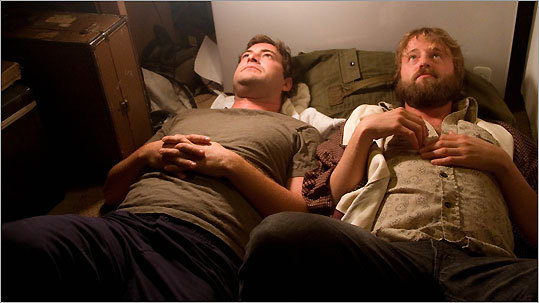
Perhaps I'm biased because it is a product of Seattle, but Lynn Shelton's most recent film, Humpday, is the best example I have seen of the so-called and fledgling mumblecore genre so far. It has a focus and forward moment that no other film of its ilk has yet exhibited.
For those who don't know, the basic tenants of mumblecore are thus: ultra-low budget with an equally low-fi visual aesthetic. There is usually no script, but rather a list of outlined scenes that the actors improvise and rehearse their way through, to mixed results. Plot and character wise, almost all films in the genre focus on over-educated 20-somethings meandering aimlessly through life, often played by the filmmakers themselves. It all comes off as a little self-indulgent.
The goal of having the actors completely improvise their scenes is to pump up the authenticity and verisimilitude, but more often than not the players end up stating the subtext of the scene out loud, and it unfolds more like a therapy session than a riveting piece of drama or hilarious piece of comedy. I appreciate the intent behind this method; we need truth and originality in cinema where ever we can get it. But it takes a steady and precise directorial hand to pull off the right balance between truth and drama. Luckily, Seattle native Lynn Shelton has that hand.
Shelton's third and most recent film, 2009 Sundance darling Humpday, is very good, but not without its flaws. The camera work is inexcusably sloppy, and a few of the scenes do fall victim to the boring therapy rut mentioned above. But these are outweighed by the film's enjoyable traits. Shelton may not yet be a master of beautiful images (which is required to be a great filmmaker), but her skill with actors is approaching genius. In Humpday more than almost any other film, we get a sense that we are flies on the wall; this story is not being presented to or performed for us. We just happen to be there to see these events transpire. The characters speak the way real people do (sometimes to a maddeningly mundane degree), and there is an overriding aura of genuine spontaneity. It is a pure and sometimes exhilarating joy to see things unfold.
As alluded to, one problem with the film (and indeed all of mumblecore) is the lack of attention paid to creating deliberate, compelling, and well composed images. Cinema is, above all else, a visual medium. Writing and acting are indeed important elements, but they are only the skeleton upon which to place the images, the meat of cinema. By ignoring this, Shelton and her mumblecore comrades are forgetting why films are important and what makes them live. Humpday is a good idea for a film, but it doesn't really do anything that couldn't be accomplished by a stage play.
I think mumblecore has valuable things to offer, but it will never rise to great cinematic heights as long as the images are neglected. We are still waiting for a film that harnesses the methods of mumblecore to tell a compelling, unusual story in a film powered by beautiful images.

Monday, January 4, 2010

Review: Vanished Empire


Director Karen Shakhnazarov's Vanished Empire can most succinctly be described as an amalgam of the book Catcher in the Rye and the Coen bros' recent film A Serious Man, but set in 1970's Soviet Russia. The similarities to Salinger's novel in particular are quite pronounced, and the film almost reads like a back-door screen adaption of the notoriously anti-Hollywood author's work. Our Slavic Holden Caulfield is Sergey, a freshman at some generic Moscow university who spends his time striking up neglectful relationships with co-eds and pawning off his grandfather's antique literature to pay for vodka and contraband Western LPs.
To an American, Vanished Empire feels at first blush like a typical European existentialist coming of age film; the camera work is mostly handheld and sloppy, events transpire without much explanation, and it is all cast in a flat, beige color palette. While this film mostly falls under that description, it does have a few aspects that make it worth watching. First is the acting. All the players are quite naturalistic and understated, which is par for the course with regard to European cinema. The standout performance, however, is delivered by newcomer to the screen Yegor Baranovsky as Sergey's earnest best friend and classmate Stepan. Though not the focus of the film, Baranovsky brings a smoldering honesty to the role that cements him as the moral and emotional center of the piece. As Sergey makes increasingly morally questionable choices, ergo becoming difficult to sympathize with, we are able to latch onto Stepan as an anchor of integrity.
Another value that this film has, especially to a Westerner, is as a window into the later years of the Soviet Union. During much of the 20th century, the USSR was painted as the Evil Empire, and there was not much importation into this country of their culture and arts; this is a drought that persists even today. So films like this one are invaluable to help humanize a people who were our supposed enemies.
Thirdly on the short list of reasons to see Vanished Empire is the final scene. We'll not spoil it here, but rest assured that it makes the entire experience worthwhile. It is a coda like none this critic can think of.